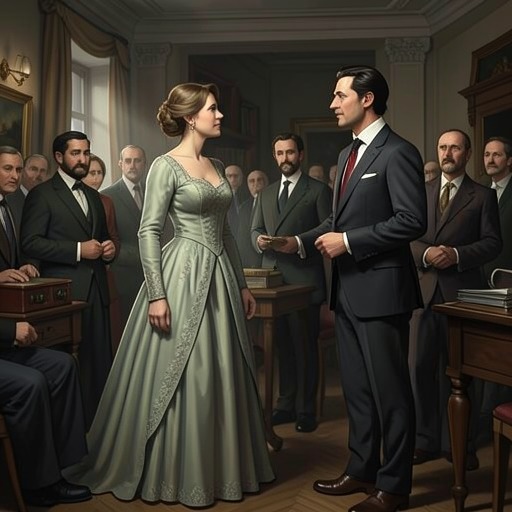
Jeanine Armenieu and Marco Santoni
Maigret and the Dead GirlThe marriage of Jeanine Armenieu and Marco Santoni turns a relationship known largely through other people’s observations into a public event, but its consequences are first visible in the life Jeanine leaves behind. Santoni’s established social world, Jeanine’s abrupt rise into more expensive surroundings, and her concealed departure from her friend all frame the wedding. After the couple travel to Italy for their honeymoon, the marriage also becomes part of Maigret’s investigation into the murder of Louise, Jeanine’s former friend.
The couple and the early relationship
Santoni is forty-five, described as good-looking, slightly stout, and carefully groomed. He frequents night clubs, bars, and leading restaurants, and his previous mistresses have mostly been models or dancers. Jeanine, by contrast, did not belong to his usual circle. An investigator estimates that Santoni met her about four or five months before the wedding, but Santoni had not told anyone where he found her. The contrast establishes a difference in their backgrounds as the relationship begins, without explaining what first drew them together.
Jeanine was twenty-two. Soon after meeting Santoni, she moved into the Hôtel Washington on Rue Washington. He often visited her there, and she sometimes spent a night at his apartment. These details show a relationship already involving regular visits and time in each other’s private spaces before the wedding. The account does not supply a proposal, a description of their feelings, or a fuller chronology of their courtship; their shared life is presented through the practical arrangements and outward changes that others could observe.
Changes before the wedding
Madame Marcelle, who had housed Jeanine and Louise, recalls a marked change in Jeanine during the final months before she left. Jeanine dressed better, in more expensive clothes, and began going to places above the level of those she had previously frequented. She sometimes stayed away for two or three days. Flowers arrived for her, as did boxes of chocolates from the Marquise de Sévigné. The gifts and altered habits gave the landlady reason to conclude that Jeanine had entered a new social world; she later connected these changes with Santoni.
Jeanine eventually told Madame Marcelle that she was leaving for good. She spoke with confidence about the prospect that her departure would later become known through the newspapers, and answered a joking question about an invitation by saying she would send a present instead. In retrospect, Madame Marcelle believed Jeanine had already met Santoni and read her small smile as a sign of confidence. That recollection does not provide direct access to Jeanine’s intentions, but it links the anticipated marriage to the decisive change in her living circumstances.
Wedding and departure
The wedding reception took place at Le Roméo, a new night club on Rue Caumartin. On the Monday night in question, the club had been rented for the wedding and was closed to ordinary customers. A newspaper account identified the occasion as the marriage of Marco Santoni, a representative in France for an Italian vermouth brand, and Jeanine Armenieu, described as having no occupation and as being from Paris. The reception drew many guests; Santoni was said to be popular in fashionable circles. The setting makes the wedding a public celebration within his social world, even though the relationship had not been explained to that world through a known account of how the couple met.
Jeanine’s departure from her former lodging was less public. She had admitted to Madame Marcelle that she planned to leave without telling Louise and intended to ensure that Louise would not discover her destination. She carried out that plan while Louise was away, leaving with two suitcases. She gave the landlady no forwarding address either, so that Louise could not trace her through the lodging. Thus the wedding follows a break in Jeanine’s closest established friendship: her new marriage coincides with a deliberate severing of contact with the friend she had shared an apartment with.
The marriage in the investigation
By the time Madame Marcelle recounts these events, Jeanine and Santoni are married and honeymooning in Italy. The relationship therefore has reached its public outcome, but the couple’s absence does not keep them outside the murder inquiry. Maigret manages to reach them by telephone through a head waiter who had worked in Paris and spoke some French. After the message is delivered, Santoni answers in an aggressive voice and objects to his wife being pursued. Maigret explains that the police are concerned with a former girlfriend of Jeanine’s who has been murdered, not with Jeanine herself.
The inquiry gives the marriage an immediate connection to the case: a letter had been entrusted to Jeanine, and Maigret tells Santoni that it may enable the police to proceed. The evidence does not establish what Santoni knows about the letter or how he responds to its significance. His first recorded reaction is to challenge the police contact on his wife’s behalf; Maigret’s reply distinguishes the newly married woman from the murder victim while making clear that Jeanine’s possession of the letter matters to the investigation.
Significance and limits of the account
The marriage is presented through a contrast between visible advancement and hidden rupture. Jeanine’s improved clothes, better outings, flowers, and chocolates signal a changed life before the wedding, while her departure with two suitcases and no address leaves Louise excluded from it. Santoni’s fashionable connections make the reception a substantial social occasion; Jeanine’s previous home, by comparison, is defined by the friend she leaves behind. The account establishes the sequence and its consequences for Louise, but does not say that Santoni ordered or knew about the secret departure.
Nor does it turn the wedding into a complete portrait of the couple’s private relationship. The evidence records their ages, Santoni’s habits, Jeanine’s move to the Hôtel Washington, his visits, her occasional stays at his apartment, and their honeymoon in Italy. It identifies this as Santoni’s first marriage and describes Jeanine as newly established in his social world, but supplies no account of married life beyond the honeymoon and the telephone call. The marriage matters both as the culmination of Jeanine’s abrupt change in circumstances and as the route by which a letter relevant to Louise’s murder becomes reachable through the couple in Italy.